

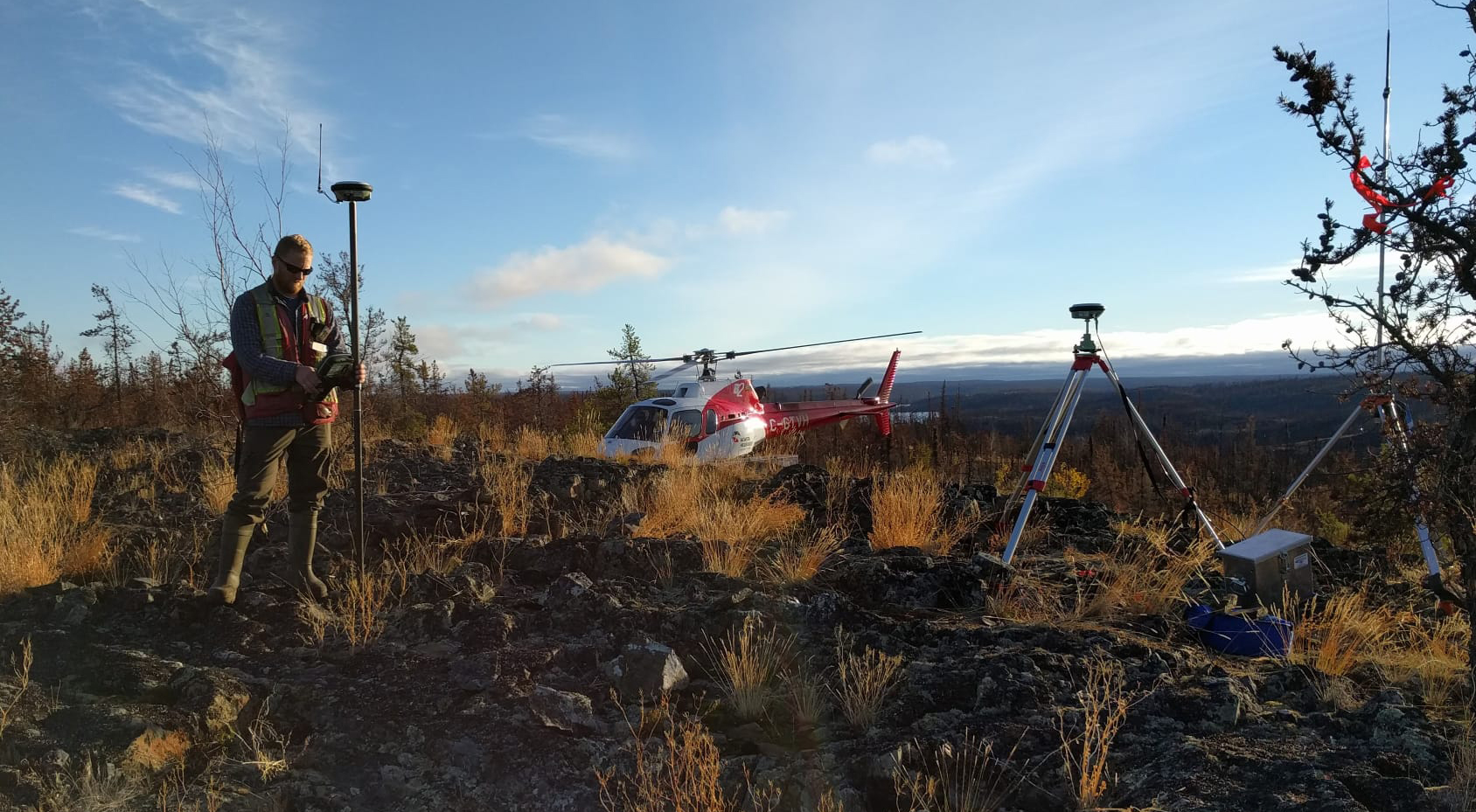
Gravity methods, also called gravimetry, detect minor changes in density in the Earth. Surprisingly for most, gravity varies quite a bit across the Earth. These changes aren’t enough for people to feel during our day-to-day, but using sophisticated instruments geophysicists can use these changes to detect buried features, be that ore bodies, buried objects, voids, and so on.
For example, in mineral exploration, common ore-associated minerals like pyrite (in sulfides deposits) or magnetite (in iron oxide deposits) are far more dense than other minerals. Where these accumulate will likely produce density variations that gravity methods can detect.
For ground surveys, Axiom maintains a fleet of Scintrex CG-6 gravity metres. The CG-6 is an industry-leading geophysical instrument that is both rugged and highly dependable. An extremely precise instrument (<0.001 mGal),it is capable of detecting even minor density variations associated with things like voids and kimberlites.
Since ground gravity is measured at and on a stable surface, it has greater sensitivity and higher resolution compared to airborne gravity surveying. Ground surveys are often conducted to refine anomalies and targets initially observed in airborne surveys.
Airborne surveys are still ideal in cases where maximizing data coverage quickly is necessary. Axiom offers airborne gravity surveys using the NxTTM system.
Axiom’s combined in-house expertise with gravity surveying spans multiple decades with its use in exploration and geotechnical applications. Standard data deliverables include Bouguer and complete Bouguer corrected (i.e., terrain corrected) data in formats used by industry-standard software. Axiom can also produce 3D gravity inversion model, if desired.
Common Applications:
- Ore body targeting
- Structure and faults mapping
- Void or karst detection (microgravity surveying)
- Landfill mapping
- Bedrock depth variation
- Buried object detection
- Tectonic structure
- Archeology